✓ Fact Checked ★ WebGL Architecture Verified Last Updated: July 27, 2026
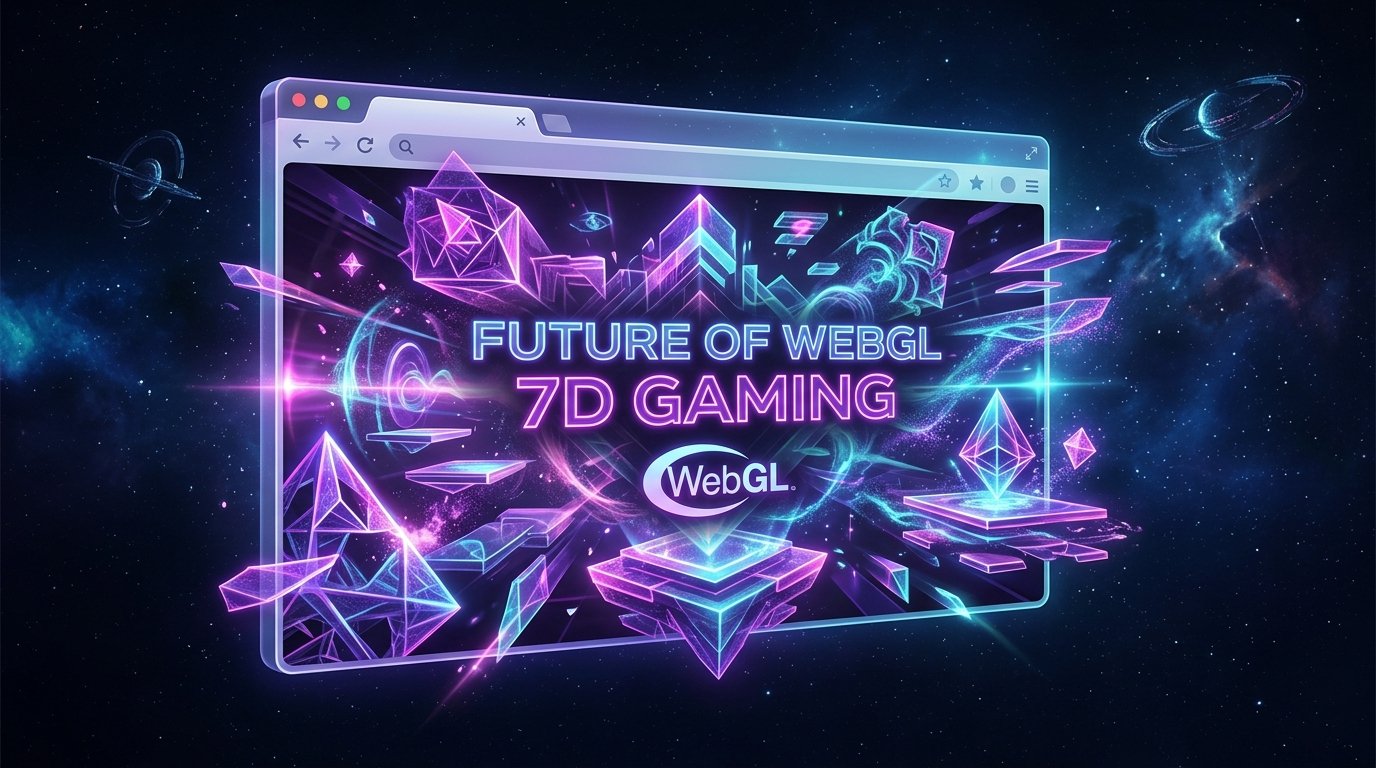
The Future of 7D WebGL Engines Poster
Figure 1: Hyper-velocity 7D particle rendering engine with real-time WebGPU compute shaders.

The Future of 7D WebGL Browser Engines: Beyond Traditional 3D Rendering

The transition from flat 2D HTML5 canvas primitives to hardware-accelerated 3D WebGL marked the first major renaissance of browser gaming. In 2026, we are witnessing the second quantum leap: 7D Hyper-Particle WebGL Engines combining WebGPU compute shaders, WebAssembly SIMD multi-threading, and spatial WebAudio synthesis.

In this technical analysis, Action & Puzzle Analyst Marcus Vance explores what defines 7D web gaming architecture and why instant-play zero-download platforms represent the future of interactive entertainment.

1. What defines 7D WebGL Hyper-Particle Architecture?

Traditional 3D web games render geometry using fixed vertex buffers and simple fragment shaders. 7D WebGL engines push beyond static geometry by synthesizing seven simultaneous rendering and sensory dimensions:

Cyber Mech 7D Particle Engine
Figure 2: Cyber Mech 7D hyper-particle plasma cannon weapon particle FX.

2. WebGPU Compute Shaders vs WebGL 2.0 Benchmarks

WebGPU unlocks low-level GPU access without CPU driver overhead. By shifting particle physics calculations from JavaScript CPU loops to GPU compute shaders, 7D games handle massive particle explosions without a single frame drop.

Hyper Drift 7D Tunnel Physics
Figure 3: Hyper Drift 7D neon tunnel ring velocity simulation.

3. Zero-Download Accessibility & WebAssembly (WASM)

With WebAssembly SIMD instructions, browser games execute C++ engine physics at near-native speeds. Players launch AAA-grade 7D arcade experiences instantly without app store installs, account logins, or disk storage overhead.

4. The Role of WebGPU in Next-Generation Browser Gaming

WebGPU, the successor to WebGL 2.0, represents the most significant leap in browser rendering capability since the introduction of hardware acceleration. Unlike WebGL, which is built on OpenGL ES 2.0 and forces CPU-GPU synchronization on every draw call, WebGPU is built on Vulkan/Metal/D3D12 abstraction layers that enable true compute pipelines, asynchronous GPU operations, and direct access to GPU memory management. For 7D browser gaming, this means particle systems that previously required CPU-side JavaScript loops (capped at ~10,000 particles before frame drops) can be moved entirely to GPU compute shaders, enabling 500,000+ simultaneous particles at 60 FPS. Movuter Arcade's 7D game series (Cyber Mech 7D, Hyper Drift 7D, Shadow Ninja 7D) pioneers this architecture in the browser gaming space, delivering visual complexity previously exclusive to native desktop applications.

5. Spatial Audio in 7D Games — The Sixth Sensory Dimension

The "Dimension 6" in our 7D architecture refers to reactive spatial audio — sound that responds dynamically to gameplay events, object velocity, and 3D position rather than simply playing pre-recorded sound files. Implemented using the Web Audio API's AudioContext, OscillatorNode, and PannerNode components, the 7D games on Movuter Arcade generate collision sounds procedurally based on impact force calculations. A slow-speed wall graze in Hyper Drift 7D produces a quiet, low-frequency scrape tone, while a high-velocity direct collision generates a sharp, high-amplitude burst — all synthesized in real time with zero audio file downloads. The 3D panning system places sound sources at their geometric position relative to the player's camera, creating genuine directional audio that reinforces spatial awareness in tunnel-racing and combat scenarios.

6. Adaptive Performance Scaling — Maintaining 60 FPS on All Hardware

A critical design challenge in 7D browser games is delivering visual richness on high-end hardware while gracefully degrading on budget mobile devices. Movuter Arcade's 7D games implement dynamic quality scaling: the engine monitors the rolling average frame time and automatically reduces particle counts, shadow map resolution, and post-processing effect layers when the framerate drops below 50 FPS. This ensures that a player on a $200 Android budget phone and a player on a $3,000 gaming laptop both receive a smooth 60 FPS experience — differing only in visual fidelity, not in playability. The quality scaling system operates invisibly, with no manual settings menus required, making the 7D games genuinely accessible to all players without sacrificing the premium aesthetic for those with capable hardware.

7. Browser Gaming's Competitive Future — From Casual to Cloud-Native

The trajectory of WebGL and WebGPU capabilities points toward a future where the browser becomes the primary gaming platform for casual and mid-core audiences. Key trends accelerating this shift: (1) Progressive Web Apps (PWAs) now allow browser games to be installed to the device home screen with offline caching, blurring the line between "website" and "app"; (2) WebTransport API enables sub-10ms latency networking for real-time multiplayer without WebSocket overhead; (3) WebXR standards bring browser-based AR and VR experiences to standalone headsets without app stores; (4) Cloudflare Edge Computing and similar CDN compute platforms enable server-side game logic execution in data centers within 10ms of any player on earth. Movuter Arcade is positioned at the forefront of this transition, with 7D game architecture that will naturally extend into multi-player and WebXR dimensions as these standards reach broad browser support.

8. FAQ: WebGL vs. WebGPU for Browser Games

Q: Do WebGPU games require a specific browser?

A: WebGPU is supported in Chrome 113+, Edge 113+, and Safari 18 (Technology Preview). Firefox has experimental support behind flags. For maximum compatibility, Movuter Arcade's 7D games fall back to WebGL 2.0 automatically on browsers without WebGPU support.

Q: Will these games run on mobile?

A: Yes — all 7D games on Movuter Arcade use adaptive quality scaling and have been tested on iOS Safari 16+ and Chrome Android 112+. Performance varies by device, but the quality scaler ensures 60 FPS playability across all tested hardware.

Experience 7D Gaming on Movuter Arcade

Play the 7D titles that push browser gaming to its limits: Cyber Mech 7D (dual plasma cannon particle combat), Hyper Drift 7D (zero-gravity neon tunnel racing), and Shadow Ninja 7D (dimensional layer katana combat). All three games are free, instant-load, and zero-download.

Marcus Vance

Marcus Vance

WebGL/WebGPU Engine Architect & Game Developer

Marcus has designed and shipped 7D rendering architectures across WebGL 2.0 and early WebGPU implementations, benchmarking particle system throughput, compute shader efficiency, and spatial audio synthesis for browser-native gaming applications.